By The Leaders Spirit | Global Finance & Geopolitics
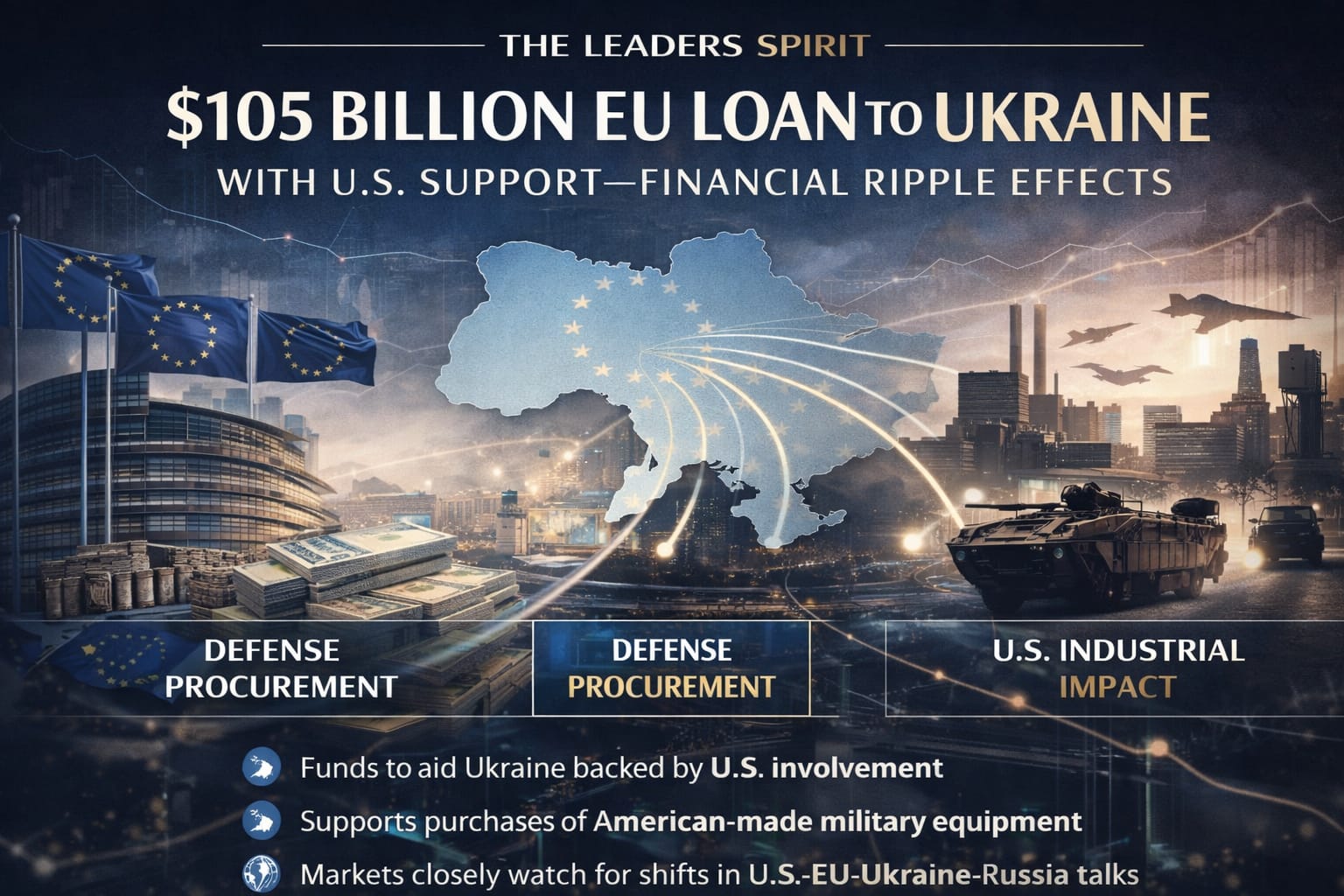
The European Union’s agreement to extend $105 billion in financial assistance to Ukraine, backed in part by strategic coordination with the United States, marks one of the most consequential intersections of global finance, defense economics, and geopolitical risk in recent years. While the funds are primarily aimed at sustaining Ukraine’s defense and economic stability, the implications extend far beyond Eastern Europe—reverberating across U.S. capital markets, defense manufacturing, and global investor sentiment.
At its core, the financing package underscores Europe’s long-term commitment to Ukraine amid an ongoing conflict that has reshaped geopolitical alliances and redrawn economic priorities. Structured largely as long-term loans rather than outright grants, the funding is designed to ensure continuity in defense spending, infrastructure resilience, and public-sector stability, even as Ukraine’s domestic revenues remain under strain.
A Strategic Financial Architecture
The loan package is supported by guarantees from EU member states and coordinated closely with Washington. While the U.S. is not the primary lender, American involvement plays a crucial role—particularly in shaping how the funds are deployed. A significant portion of the financing is expected to be used for defense procurement, much of it sourced from U.S.-based defense contractors.
This structure effectively links European sovereign financing to American industrial output. Major U.S. defense firms stand to benefit indirectly as Ukraine replenishes equipment, ammunition, and advanced systems—orders that are often fulfilled through U.S. manufacturing pipelines. For investors, this creates a clear transmission channel between geopolitical developments and corporate earnings in the defense and aerospace sectors.
Market Implications for U.S. Investors
From a market perspective, the loan announcement reinforces a trend already visible in global portfolios: the repricing of geopolitical risk. Defense stocks, already buoyed by rising global military expenditures, are likely to see sustained demand as long as uncertainty persists in Eastern Europe. Analysts note that long-term funding commitments such as this reduce volatility for suppliers, offering greater earnings visibility.
Beyond defense, the move also affects currency markets, sovereign bond yields, and risk premiums. The euro’s exposure to long-term Ukrainian financing adds complexity to European fiscal outlooks, while U.S. markets are watching closely to see how extended geopolitical commitments influence inflation, government spending, and monetary policy expectations.
Geopolitics and Peace Negotiations
The financing decision comes at a sensitive moment, with peace negotiations involving the U.S., EU, Ukraine, and Russia remaining fluid and uncertain. Markets are increasingly sensitive to any signals—positive or negative—emerging from diplomatic channels. A breakthrough could rapidly shift capital flows, while prolonged stalemate may entrench current defense-led investment themes.
For investors, this uncertainty reinforces the importance of geopolitical literacy. Risk is no longer confined to economic indicators alone; diplomatic developments now play a direct role in shaping sectoral performance and asset allocation strategies.
Debt, Durability, and Long-Term Questions
While the loan provides Ukraine with much-needed liquidity, it also raises longer-term questions about debt sustainability and post-conflict reconstruction. European policymakers argue that the cost of inaction would be far higher—both economically and strategically. By anchoring Ukraine’s finances today, the EU aims to stabilize the region and prevent broader spillover risks.
For the U.S., the arrangement reflects a model of influence without direct fiscal outlay at the same scale, while still reinforcing domestic industries and strategic alliances.
A New Era of Financial-Statecraft
Ultimately, the $105 billion EU loan is more than a financial transaction—it is a case study in modern financial-statecraft. Capital is being deployed not just to generate returns, but to shape outcomes, reinforce alliances, and manage systemic risk.
For U.S. and global investors, the message is clear: geopolitics is now a core financial variable. Understanding how government funding, defense procurement, and international alliances intersect is no longer optional—it is essential.
As markets continue to navigate an era defined by uncertainty and strategic competition, developments like this will remain pivotal in determining where capital flows—and why.