A signal of resilience within Russia’s banking sector amid rising corporate stress
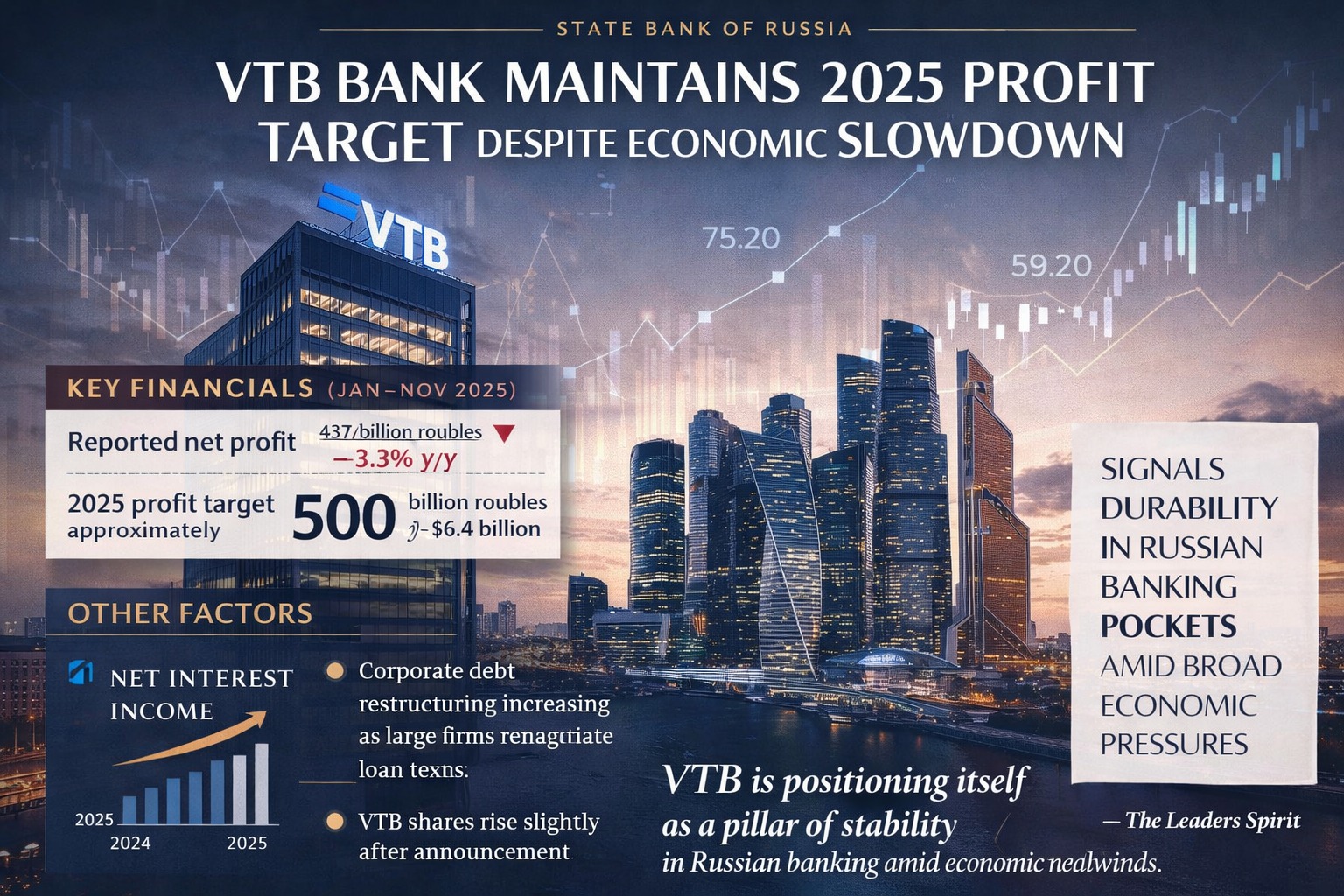
Russia’s second-largest state-owned lender, VTB Bank, has reaffirmed its 2025 net profit target of 500 billion roubles (approximately USD 6.4 billion), projecting confidence in its long-term strategy despite a visible slowdown in near-term earnings. The announcement comes at a time when Russia’s financial sector is navigating complex macroeconomic pressures, including high interest rates, corporate debt restructuring, sanctions-related constraints, and subdued investment sentiment.
For the January–November period, VTB reported a year-on-year decline of roughly 3.3% in net profit, totaling 437.2 billion roubles. While the headline figure suggests pressure on earnings, the underlying financial performance tells a more nuanced story—one that reflects both strain and structural strength within Russia’s banking ecosystem.
Profit Stability in a Challenging Climate
VTB’s decision to maintain its profit outlook is significant, not only for shareholders but also for policymakers and corporate borrowers who view the bank as a cornerstone of Russia’s financial system. As a systemically important institution with extensive exposure to corporate lending, infrastructure financing, and state-linked enterprises, VTB’s health is often interpreted as a barometer for broader economic stability.
The bank’s leadership emphasized that core operating performance remains strong, supported by improved margins and disciplined risk management. Despite slower economic growth and rising costs of capital, VTB has demonstrated an ability to adapt its balance sheet strategy to prevailing conditions.
Market reaction to the announcement was cautiously positive. VTB shares edged higher on the Moscow Exchange, signaling investor confidence in the bank’s ability to weather current challenges and deliver on its longer-term profitability goals.
Net Interest Income Drives Resilience
One of the most notable aspects of VTB’s recent performance has been the sharp increase in net interest income, which rose by approximately 2.5 times compared to the previous year. This surge reflects the impact of Russia’s elevated interest-rate environment, which has allowed banks to widen lending margins—particularly on corporate and commercial loans.
High benchmark rates have enabled lenders like VTB to reprice credit more aggressively, offsetting some of the pressures from rising provisioning costs and slower loan growth. The improvement in interest income has played a crucial role in cushioning the impact of weaker fee-based revenues and higher operational expenses.
However, analysts caution that this benefit may not be permanent. Sustained high interest rates, while profitable in the short term, can increase default risks and suppress borrowing demand over time. VTB’s ability to maintain strong interest income while managing credit quality will be a key determinant of whether its profit target remains achievable.
Rising Corporate Debt Restructuring
A growing challenge for VTB—and for the Russian banking sector more broadly—is the increase in corporate debt restructuring. Large companies across industries are renegotiating loan terms in response to tighter financial conditions, rising refinancing costs, and uneven cash flows.
For VTB, this trend reflects both risk and opportunity. On one hand, restructuring activity can pressure earnings through delayed repayments, modified interest terms, or increased provisioning requirements. On the other hand, it allows the bank to preserve long-term client relationships, stabilize loan books, and prevent abrupt defaults that could have wider systemic consequences.
Executives have indicated that most restructurings are precautionary rather than distress-driven, suggesting that many corporate borrowers remain fundamentally viable but are seeking flexibility to navigate short-term liquidity constraints. This approach aligns with broader efforts by Russian financial authorities to maintain stability and avoid cascading credit events.
A Broader Signal to the Banking Sector
VTB’s reaffirmation of its profit target sends a broader signal to domestic and regional markets: Russia’s largest banks are prioritizing continuity and confidence, even in an uncertain economic environment. While external pressures remain—from geopolitical tensions to capital access limitations—the banking system has thus far avoided severe disruption.
State backing plays an important role in this resilience. As a government-controlled institution, VTB benefits from policy alignment and strategic support, enabling it to operate with a longer time horizon than purely private lenders. This positioning allows the bank to absorb short-term volatility while maintaining commitments to large-scale financing projects.
Nevertheless, experts note that the sustainability of this model depends on careful balance. Prolonged economic stagnation or a sharp deterioration in corporate credit quality could test even the most well-capitalized institutions.
Outlook: Confidence with Caution
Looking ahead, VTB’s path to achieving its 2025 profit goal will depend on several factors: interest-rate policy, corporate credit conditions, capital adequacy, and broader economic momentum. While management’s confidence is grounded in strong interest income and disciplined restructuring practices, risks remain elevated.
For investors and industry observers, the key takeaway is not just the headline profit target, but the message behind it. VTB is positioning itself as a pillar of stability, reinforcing the narrative that Russia’s financial institutions are adapting—rather than retreating—in the face of ongoing challenges.
As global markets continue to reassess geopolitical risk and emerging-market resilience, VTB’s performance will remain closely watched. Its ability to combine profitability with prudence may well define the next phase of Russia’s banking evolution.